
Introduction
Many beginners feel confused when choosing banks for saving or investing money. Friends often ask why banks feel similar but work very differently. This confusion grows when people hear complex banking words online. Investment bank vs commercial bank differences help clear this confusion quickly.
This topic explains why banks serve different money goals clearly.
Some banks help raise money while others protect savings safely. When you understand banking roles, money decisions feel easier.
This guide talks like a friend explaining things simply. You will learn which bank fits your money needs. We explain job services, risks, and safety clearly. We use real examples that beginners can easily understand.
This blog saves time and avoids confusing terms. After reading, you will know banking basics confidently. You will compare banks without fear or stress. This article helps beginners make smarter money choices.
What Is an Investment Bank and a Commercial Bank?
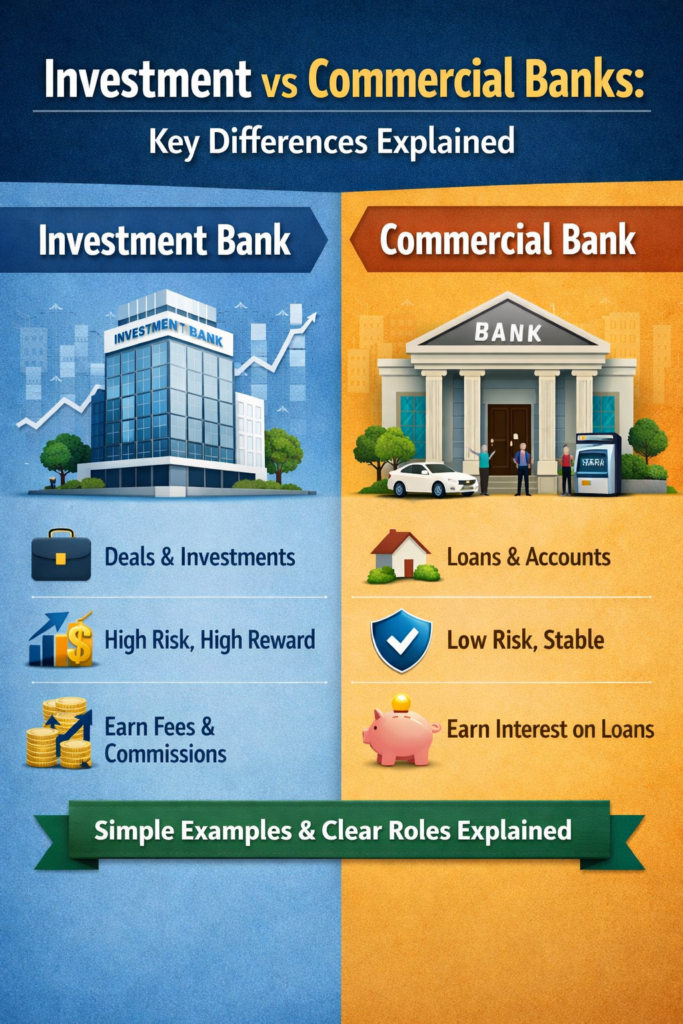
Let us talk simply about banks like friends. Investment bank vs commercial bank differences explain the bank’s purpose clearly. Investment banks focus on big-money projects mostly. Commercial banks focus on saving, lending, and safety.
Both banks support money flow differently. Their roles, services, and risks differ clearly. Understanding this topic helps beginners choose wisely.
Types of Banks Explained Simply
Banks are not the same, even if names sound similar. Each bank type serves different money needs. Knowing types avoids costly money mistakes.
Investment Banks
Think of investment banks as big money helpers. They help companies raise large funds.
They work closely with stock markets.
The functions of investment banks focus on capital growth. They guide companies during mergers and expansions. They handle complex financial deals carefully.
Services offered by investment banks include advice and fundraising. They help issue shares and bonds. They connect investors with companies.
The role of investment banks in capital markets is very important. They move money between investors and businesses. They support economic growth through investments.
Investment banking income sources come mostly from fees. They earn from deals and advice. Market success affects their earnings strongly.
Risk in investment banking is usually high. Market changes can cause losses. Rewards can also be very high.
Investment bank examples include Goldman Sachs and Morgan Stanley. These banks work with large companies. They rarely deal with everyday customers.
Commercial Banks
Commercial banks feel more familiar to people. They serve normal customers and businesses.
They focus on safety and trust.
The functions of commercial banks focus on saving and lending. They accept deposits from customers. They give loans to people and businesses.
Services offered by commercial banks include accounts and cards. They offer home loans and business loans. They provide payment and transfer services.
The role of commercial banks in the economy is very stable. They support spending and business growth. They keep money moving safely.
Commercial banking income sources come from interest mainly. Loan interest brings steady earnings. Fees also add small income.
The safety of commercial banks is usually strong. Government rules protect customer money. Deposit insurance adds extra safety.
Commercial bank examples include Chase and Bank of America. These banks serve millions of people. They handle daily money needs.
Investment Bank vs Commercial Bank Comparison
Let us compare both banks simply like friends. This section explains the clear differences easily. Beginners can understand without stress.
Investment bank vs commercial bank table
Investment bank vs commercial bank differences become clear here. This comparison helps quick understanding. Each point explains real differences.
Investment banks focus on big deals and markets. Commercial banks focus on savings and loans. Both serve money but in different ways.
Investment banks face high market risks often. Commercial banks focus on safety and rules. Risk level differs greatly between them.
Investment banks earn fees from deals mostly. Commercial banks earn interest from loans. Income sources work very differently.
Investment banks serve companies and investors. Commercial banks serve people and small businesses. Customer types clearly differ here.
Investment Bank vs Retail Bank
People often confuse retail banks with commercial banks. Retail banks are part of commercial banks. They serve everyday personal needs.
Investment bank vs retail bank differences are very clear. Retail banks handle savings and cards. Investment banks handle big financial deals. Retail banking feels simple and safe.
Investment banking feels complex and risky. Both help the economy differently.
Investment Bank vs Commercial Bank for Beginners
Let us simplify this topic even more. Beginners need clear, simple explanations.
This section removes fear completely.
Investment bank vs commercial bank for beginners means purpose clarity. Ask yourself what money goal you have. Saving or investing makes a difference.
Choose commercial banks for safety and savings. Choose investment banks for growth projects. Your goal decides the right bank.
Understanding investment bank vs commercial bank differences builds confidence. Confidence helps make better money decisions. Knowledge always reduces mistakes.
Frequently Asked Questions
What is the main difference between investment and commercial banks?
Investment banks focus on markets and big deals. Commercial banks focus on saving and lending. Both banks serve money differently.
Are investment banks riskier than commercial banks?
Yes, investment banks face market risks often. Commercial banks follow strict safety rules.
Risk levels differ clearly.
Can normal people use investment banks?
Most people do not use investment banks. They serve large companies and investors.
Commercial banks serve normal customers.
Which bank is safer for beginners?
Commercial banks are safer for beginners. They protect deposits through rules. Investment banks carry higher risks.
Why do companies use investment banks?
Companies need funds for growth projects. Investment banks help raise money.
They guide complex financial deals.