
Introduction
Have you ever wondered why prices rise and jobs disappear together? Many students feel confused when learning micro vs. macro economics for the first time. This topic feels hard because books explain ideas using boring language.
You might struggle to understand how small markets connect with the national economy. Here, micro vs macro economics helps explain problems using simple thinking.
Micro explains small choices, and macro explains big country-level results. This guide explains micro vs macro economics in a friendly, easy conversation. You will learn definitions, comparisons, and charts without stress. After reading, you can understand exam news and daily money decisions.
This article solves confusion by breaking ideas into small, clear steps. You will see how micro vs. macro economics connects with real life. Let us start learning together like friends, talking about money basics.
What Is Micro vs Macro Economics?
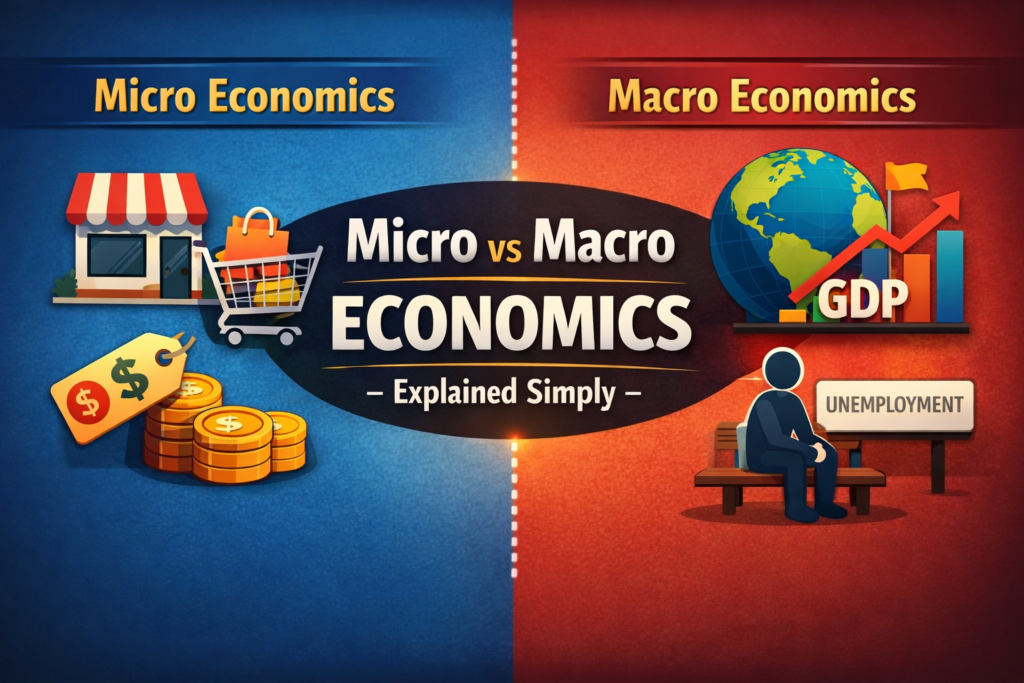
Micro vs. macro economics explains the economy using small and large views. Micro focuses on people, markets, prices, and choices made daily. Macro focuses on country growth, job inflation, and overall economic health. Together, micro vs. macro economics helps understand the money world clearly.
This comparison helps students connect theory with real economic events. Learning micro vs macro economics makes economics easier and interesting. It also improves decision-making skills for future careers.
Microeconomics Definition Explained Simply
Let us start with the microeconomics definition using friendly words. Microeconomics studies small economic units like people and businesses. It explains how buyers and sellers make choices daily.
Demand and Supply in Microeconomics
Demand and supply (microeconomics) plays central role in microeconomics. Prices change when demand increases or supply decreases. Markets balance when demand equals supply naturally.
Consumer Behavior Economics
Consumer behavior economics explains why people buy certain products. People choose based on income, taste, needs, and prices. Businesses study behavior to set prices and improve sales.
Price Determination in Microeconomics
Price determination in microeconomics explains how prices are finally decided. Prices form through interaction between buyers and sellers. This helps clarify shopping market behavior.
Macroeconomics Definition Made Easy
Now, let us understand the macroeconomics definition in simple language. Macroeconomics studies the whole country’s economy instead of individuals. It focuses on national income, employment, inflation, and growth.
GDP and National Income
GDP and national income measure a country’s economic performance yearly. A higher GDP shows a stronger economy producing more goods. Lower GDP shows slow growth and fewer opportunities.
Inflation and Unemployment
Inflation and unemployment are major problems studied in macroeconomics. Inflation reduces the value and affects living costs. Unemployment shows people are unable to find jobs.
Fiscal Policy and Monetary Policy
Fiscal policy and monetary policy control the economy through government actions. Fiscal policy uses taxes and spending decisions. Monetary policy controls money supply and interest rates.
Difference Between Micro and Macro Economics
Now, let us see the difference between microeconomics and macroeconomics clearly. Micro studies small units, and macro studies the whole economy.
Micro focuses on prices, while macro focuses on inflation, growth, and employment. Micro helps understand individual markets and buying behavior.
Macro helps understand national problems and policy decisions. Both together explain the economy from bottom to top.
This micro vs. macro economics comparison helps students learn faster. It also helps understand news and government economic actions.
Micro vs Macro Economics Examples
Let us look at micro vs. macroeconomics examples simply. Buying a phone shows microeconomic decision-making. National phone industry growth shows the macroeconomic situation.
The price increase of milk is a microeconomics example. Country-wide food inflation is macroeconomics example. Job loss in one shop is microeconomics issue.
Nationwide unemployment rise is macroeconomics issue. These micro vs macro economics examples connect theory with reality. Examples make learning economics easy and memorable.
Micro vs Macro Economics Chart Explained
Students love visuals, so the micro vs. macro economics chart helps. The chart compares focus area, scope tools, and goals. The micro side shows individual markets and prices.
The macro side shows GDP inflation, unemployment, and growth. Charts simplify revision before exams quickly. Using a micro vs. macro economics chart improves understanding instantly. It saves time during quick exam preparation.
Economic Growth Macroeconomics Explained
Now, let us briefly discuss economic growth and macroeconomics. Economic growth means an increase in a country’s production and income. It improves living standards and job opportunities. Macroeconomics studies factors affecting long-term growth.
Education, investment in technology, and policies support growth. Understanding micro vs. macroeconomics helps see growth clearly. Micro choices together impact macro growth results.
Why Micro vs Macro Economics Is Important For Students
Micro vs. macroeconomics for students builds a strong base. It helps students understand exams and real-world news. Concepts improve thinking and decision-making skills.
Students learn how personal choices affect the country’s economy. They also understand how policies affect personal lives. Learning micro vs. macroeconomics boosts confidence in economics. It removes fear from economic topics completely.
Frequently Asked Questions
What is micro vs macro economics?
Micro vs. macro economics explains small markets and big economies. Micro studies individuals, and macro studies the whole country. Both together explain how the economy works clearly.
Why is micro vs macro economics important?
It helps understand prices, jobs, inflation, and growth. Students connect theory with real-world situations. It improves economic understanding greatly.
What is the difference between microeconomics and macroeconomics?
Micro focuses on individual markets and prices. Macro focuses on GDP inflation and unemployment growth. Both views are important together.
Is micro vs macro economics hard for beginners?
No, this topic becomes easy with simple explanations. Examples, charts, and friendly language help.
Practice makes understanding stronger.
How can students learn micro vs macro economics easily?
Students should use examples, charts, and summaries. Reading friendly guides improves understanding.
Regular revision builds confidence.